
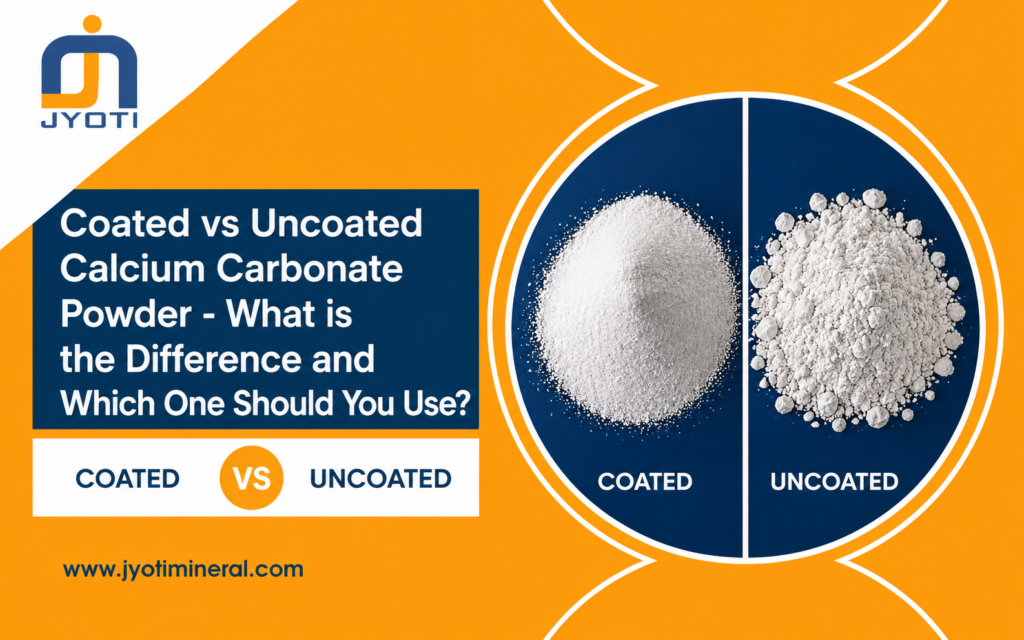
If you buy calcium carbonate powder for your factory or business, you have probably seen two options: coated and uncoated. Many people get confused between these two. They look the same. Both are white powders. So what is actually different?
In this blog, we will explain everything in the simplest way possible. By the end, you will know exactly which one is right for your industry.
What is Calcium Carbonate Powder?
Calcium carbonate (CaCO3) is a white mineral powder made from natural limestone or calcite rocks. It is used in many industries as a filler material – meaning it is added to products to improve quality and reduce cost. It is widely used in plastics, PVC pipes, rubber, paints, WPC sheets, and paper. It is one of the most important raw materials in manufacturing today.
What is Uncoated Calcium Carbonate Powder?
Uncoated calcium carbonate is the natural, raw form of this mineral. It is simply crushed and ground into fine powder. No chemical is added to its surface.
Simple features:
- Pure and natural mineral form
- Lower cost
- Good whiteness
- Absorbs moisture easily
Best used in: Construction materials, paper manufacturing, agriculture, and basic paints.
If your product does not need very high strength or flexibility, uncoated calcium carbonate is a good and affordable choice.
What is Coated Calcium Carbonate Powder?
Coated calcium carbonate is the same white mineral powder but with a thin layer of stearic acid applied on its surface. This coating changes how the powder behaves when mixed with plastics or rubber.
Simple features:
- Surface treated with stearic acid
- Does not absorb moisture
- Mixes much better with plastics and polymers
- Makes the final product stronger and more flexible
- Slightly higher cost than uncoated
Best used in: Calcium carbonate powder for plastics, calcium carbonate powder for PVC profiles and pipes, calcium carbonate powder for WPC sheets, rubber products, and plastic masterbatch manufacturing.
Simple Comparison – Coated vs Uncoated
- Surface Treatment: Uncoated has no surface treatment. It is pure natural powder. Coated has a thin layer of stearic acid on its surface.
- Moisture Absorption: Uncoated powder absorbs moisture easily from the air. Coated powder does not absorb moisture and stays dry even in humid conditions.
- Mixing with Plastics: Uncoated gives average mixing with plastics. Coated mixes excellently and blends smoothly without any problem.
- Product Strength and Flexibility: Uncoated gives basic strength. Coating gives higher strength and better flexibility. Products do not crack or break easily.
- Cost: Uncoated is lower in cost. Coated costs slightly more but gives better quality and fewer production rejections.
- Best For: Uncoated is best for construction, paper, and agriculture. Coated is best for plastics, PVC, rubber, and WPC sheets.
Why Does the Coating Matter?
Think about mixing oil and water. They never mix properly. The same happens when you mix natural calcium carbonate with plastic. Calcium carbonate loves water. Plastic repels water. So they do not mix well together.
The stearic acid coating solves this problem. It acts like a bridge between calcium carbonate and plastic. After coating, both mix smoothly and easily.
This is why industries using calcium carbonate powder for plastics or calcium carbonate powder for PVC profiles always prefer the coated grade. You get better surface finish, stronger products, fewer defects, and lower production cost.
How to Choose – Coated or Uncoated?
Choose Uncoated if you work in: Construction, cement, paper, agriculture, or basic paints.
Choose Coated if you work in: Plastic products, PVC pipes and profiles, WPC sheets, rubber goods, or masterbatch manufacturing.
Always ask your supplier for a sample first. Test it in your process and then place a bulk order.
Why Industries Trust Jyoti Mineral Industries
Jyoti Mineral Industries is based in Udaipur, Rajasthan – one of India’s top mineral hubs. We supply high-quality mineral powders to industries for over 15 years.
- Coated and uncoated calcium carbonate powder available
- Multiple mesh sizes as per your requirement
- Consistent whiteness and high purity
- Quality tested before every dispatch
- Bulk supply available across India
We also supply talc powder for plastics, talc powder for PVC, soapstone powder, and silica powder for various industrial needs.
Ready to Choose the Right Calcium Carbonate?
Choosing between coated and uncoated calcium carbonate is simple once you know your industry need.
If you work in plastic, PVC, rubber, or WPC – always choose coated calcium carbonate. It mixes better, gives a stronger product, and makes your production smoother.
If you work in construction, paper, or agriculture, uncoated calcium carbonate is perfectly fine and more affordable.
The right grade of calcium carbonate can improve your product quality, reduce waste, and lower your overall production cost.
Have questions or want to order? Contact Jyoti Mineral Industries today. Our team will help you pick the right grade for your business.
Common Questions About Our Services
Q 1. What is the difference between coated and uncoated calcium carbonate powder?
Uncoated calcium carbonate is simple natural powder with no treatment on it. Coated calcium carbonate has a thin layer of stearic acid on its surface. This coating helps it mix better with plastics and makes the final product stronger. For plastic or PVC products, always use coated. For construction or farming, uncoated works fine.
Q 2. Which calcium carbonate powder is best for plastic manufacturing?
Coated calcium carbonate is the best choice for plastic manufacturing. It mixes smoothly, gives a better surface finish, and makes the product stronger. Most plastic and PVC manufacturers in India prefer coated calcium carbonate powder for better results and less wastage.
Q 3. Why is stearic acid coating used on calcium carbonate powder?
Plastic and calcium carbonate do not mix well naturally. Stearic acid coating acts like a bridge between them. It helps the powder blend easily into plastic or rubber and gives better quality output with fewer defects.
Q 4. Can coated calcium carbonate be used in WPC sheets and PVC pipes?
Yes, absolutely. Coated calcium carbonate powder is widely used in WPC sheets, PVC pipes, and PVC profiles. It improves strength, reduces cost, and gives a better surface finish to the final product.
Q 5. Where can I buy good quality calcium carbonate powder in India?
Jyoti Mineral Industries, Udaipur, Rajasthan is a trusted manufacturer and supplier of coated and uncoated calcium carbonate powder in India. They supply to plastic, PVC, rubber, and WPC industries across India.