
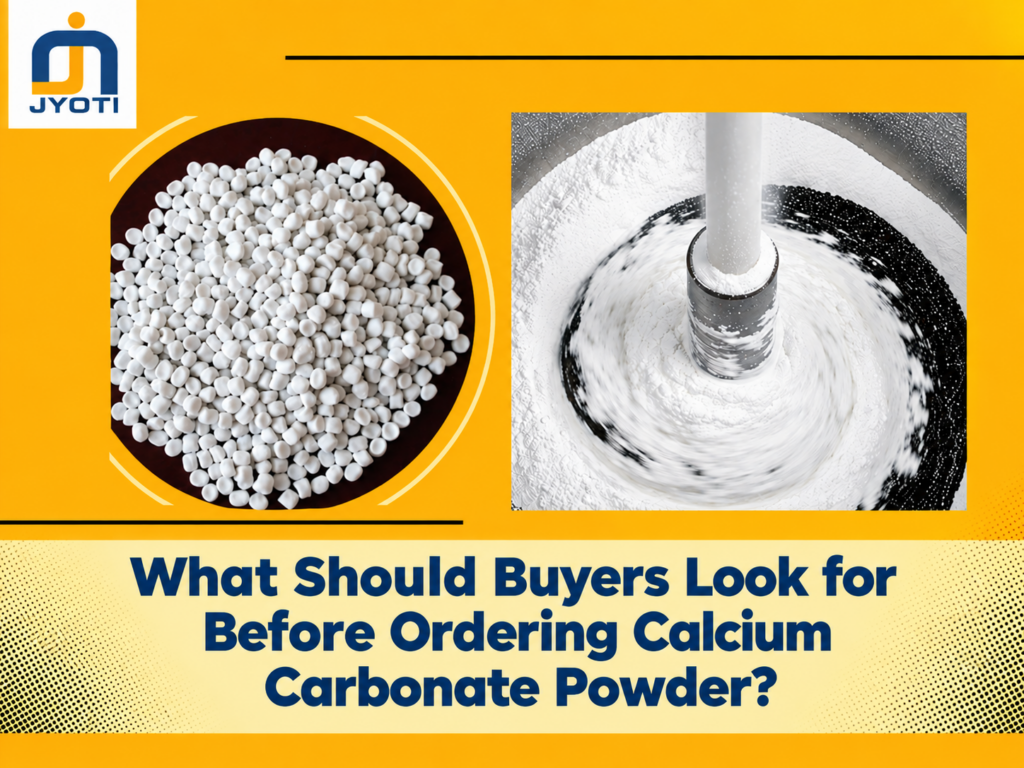
Before you order calcium carbonate powder, check five things – purity level (CaCO₃ %), particle size (mesh or micron), whether it’s coated or uncoated, whiteness/brightness, and moisture content. Then ask your supplier for a Certificate of Analysis and a working sample before you commit to a bulk order. Get these right, and you’ll save yourself a lot of production headaches later.
At Jyoti Mineral Industries, we’ve been mining, grinding, and supplying calcium carbonate powder from our facility in Udaipur, Rajasthan since 2007. In that time, we’ve seen almost every mistake a buyer can make while sourcing this material – and most of them come down to not checking the right specs upfront. So let’s break down exactly what to look for, and how we approach it here.
What Is Calcium Carbonate Powder, Really?
Calcium carbonate powder (also called calcite powder) is a naturally occurring mineral, mined and then ground down to a fine, controlled particle size. It’s one of the most widely used fillers in the world – you’ll find it in plastics, PVC pipes, paints, paper, rubber, and construction materials.
The reason it’s so popular isn’t just cost. A good quality calcium carbonate powder genuinely improves the product it’s added to – better stiffness, better opacity, smoother surface finish, and lower material cost per kg.
But here’s the catch: not all calcium carbonate powder is the same. Two bags that look like identical white powder can behave completely differently once they hit your machine. This is exactly why every batch that leaves Jyoti Mineral is ground to a controlled, consistent spec instead of a rough “one size fits all” grade.
How Does It Actually Work in Your Product?
Calcium carbonate works as a filler – it fills space in the polymer or compound, reduces the amount of costlier resin you need, and changes physical properties like density, stiffness, and surface texture.
The way it performs depends almost entirely on how fine it’s ground and how it’s treated. Fine, coated calcium carbonate disperses smoothly into plastic and blends in without leaving visible specks. Coarser or uncoated grades behave differently – they suit applications like paper coating or construction filler, where dispersion at a micro level isn’t the priority.
At our facility, we control this right from the mining stage through to grinding and packaging, so what you order from Jyoti Mineral is what actually reaches your production line – batch after batch.
Key Things to Check Before You Order
1. Purity Level
Look for a CaCO₃ purity of 98% or higher. Anything lower usually means more trace impurities – silica, magnesium, iron – which can affect colour consistency and performance in sensitive applications like paints or engineering plastics.
If purity matters a lot to your end product (say, a white masterbatch or coating), don’t skip this check. Ask for the exact percentage, not just “high purity” written on a spec sheet. We share this figure with every quote, no exceptions.
2. Particle Size (Mesh or Micron)
This is probably the single biggest factor buyers get wrong. Calcium carbonate comes in a huge range – from coarser 200 mesh grades right up to fine micro-grades used in demanding applications like Calcium Carbonate Powder For Polymer Compounding.
Finer grinding generally means:
Smoother dispersion
Better surface finish
Slightly higher cost
Coarser grinding means lower cost but can leave visible texture or reduce mechanical strength in some compounds. We grind to order based on your exact micron requirement instead of pushing whatever’s sitting in stock – match the fineness to what your machine and product actually need.
3. Coated vs. Uncoated
This one trips up a lot of first-time buyers.
Coated calcium carbonate (usually with stearic acid) is what you want for plastics, PVC, and masterbatches. The coating helps the powder disperse evenly into the polymer instead of clumping.
Uncoated grades work fine for paper, rubber, and construction use, where that level of dispersion isn’t as critical.
If you order uncoated powder for a plastics application by mistake, you’ll likely see poor mixing and inconsistent finish. We’ve had buyers come to Jyoti Mineral after running into this exact issue with a previous supplier – it’s a simple fix once you know what to ask for.
4. Whiteness and Brightness
If your end use is paint, coatings, or premium plastics, whiteness matters – a lot. Ask your supplier for the brightness value on a standard whiteness index. Two powders with the same purity can still look noticeably different once they’re in your finished product. It’s one of the properties our calcium carbonate is known for, thanks to the quality of raw mineral we source.
5. Moisture Content
Keep this under 0.3% wherever possible. Higher moisture leads to clumping in storage, inconsistent feeding into machines, and can even cause processing issues in extrusion. It sounds like a minor spec, but it’s one of the most common reasons for production delays – and one we control tightly during packaging and dispatch.
Real Example: Where This Actually Matters
Say you’re sourcing Calcium Carbonate Powder For Pvc Profiles – window frames, door profiles, that kind of thing. You’ll want:
High purity (98%+)
Coated grade for smooth dispersion
Consistent particle size, batch to batch
Now compare that to someone sourcing Calcium Carbonate Powder For Wpc Sheets (wood-plastic composite). Here the exact purity and coating requirement can shift depending on your own formulation – which is exactly why our team talks through the application with every buyer before recommending a grade, rather than pushing a standard SKU.
Same mineral, two very different specs. This is why “send me your best calcium carbonate powder” isn’t something any honest supplier can answer without knowing your application first – and it’s the first question our team at Jyoti Mineral will ask you too.
Comparison: Coated vs. Uncoated Calcium Carbonate
Factor | Coated CaCO₃ | Uncoated CaCO₃ |
Best for | Plastics, PVC, masterbatches | Paper, rubber, construction |
Dispersion | Excellent | Moderate |
Cost | Slightly higher | Lower |
Common Mistakes Buyers Make
Ordering by price alone – the cheapest quote often means a coarser grind or lower purity that costs more in rework later
Skipping the sample test – never place a bulk order without testing a sample batch on your own line first
Assuming all suppliers grind to the same consistency – batch-to-batch variation is real, and it matters more than most buyers expect
Not asking for a COA – a Certificate of Analysis isn’t a formality, it’s your proof of what you’re actually paying for
Ignoring MOQ and lead time terms upfront – this causes production planning issues down the line
These are exactly the gaps Jyoti Mineral built its process around closing – from mining our own raw material to controlled grinding and dispatch, so buyers aren’t relying on a middleman’s word for consistency.
A Simple Buying Guide
Define your application first – plastics, PVC, paint, rubber, or construction
Decide on particle size based on the finish and strength you need
Choose coated or uncoated depending on dispersion requirements
Ask for a Certificate of Analysis covering purity, pH, bulk density, and particle distribution
Request a working sample and test it on your actual production line
Confirm supplier reliability – MOQ, lead times, and consistency across batches
Place a trial order before committing to large volumes
This applies whether you’re sourcing Calcium Carbonate Powder For Plastics or any other grade in our range – the Jyoti Mineral team is happy to walk you through each of these steps before you place an order, not after.
Key Takeaways
Purity, particle size, coating type, whiteness, and moisture content are the five specs that matter most
Match the grade to your actual application – plastics, PVC, paper, or construction each need something slightly different
Always request a COA and test a sample before bulk ordering
Supplier consistency matters as much as the initial spec sheet
Why Buyers Trust Jyoti Mineral
Calcium carbonate powder looks simple on paper – it’s just a white mineral filler, right? But the right grade can genuinely improve your product, and the wrong one can quietly cost you in rework, downtime, and inconsistent quality.
That’s the whole reason Jyoti Mineral Industries runs its operation the way it does – mining, grinding, and packaging under one roof in Udaipur, so nothing gets diluted or inconsistent between what leaves our facility and what reaches your production line. We’ve been doing this since 2007, and most of our buyers stay with Jyoti Mineral because the batch they get today matches the batch they got last year.
If you’re not sure which grade fits your application – plastics, PVC, WPC sheets, or anything else – talk to us before you order, not after.
Get in touch with the Jyoti Mineral team for a sample or a quote tailored to your application.
Buyer Questions We Get Often
What purity level should I look for in calcium carbonate powder?
Aim for 98% CaCO₃ or higher for most industrial applications. Lower purity is acceptable for some construction or filler uses but check with your process requirements first.
Should I choose coated or uncoated calcium carbonate?
Coated is better for plastics, PVC, and masterbatches because it disperses more evenly. Uncoated works fine for paper, rubber, and construction filler.
Why does particle size matter so much?
Finer particle size gives smoother dispersion and better surface finish but usually costs more. Match it to your actual application instead of defaulting to the finest grade.
Can I test the powder before placing a bulk order?
Yes, and you should always do this. Jyoti Mineral provides working samples so you can test dispersion and compatibility on your own line before committing to volume.
What documents does Jyoti Mineral provide with each order?
A batch-specific Certificate of Analysis covering purity, pH, bulk density, and particle size distribution – every time, not just on request.