
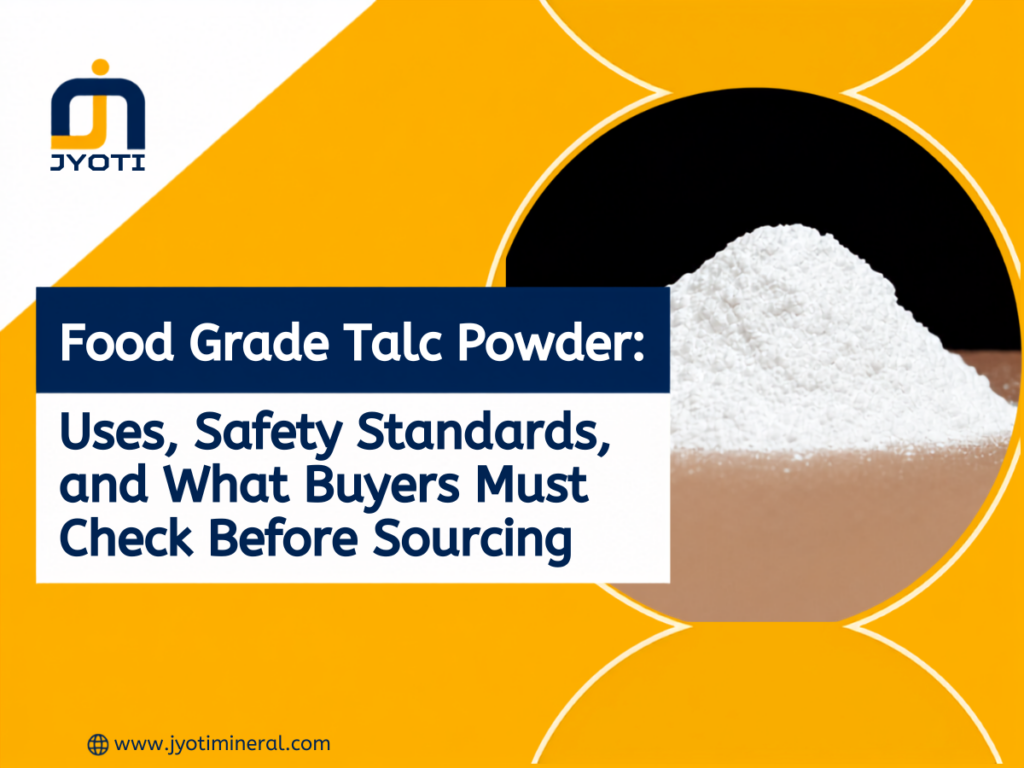
Not every talc labeled “food grade” actually meets the standard. Real food grade talc is a highly purified, asbestos-free powder used in pulses, chewing gum, sweets, and spices. It should always come with FSSAI or FCC compliance and a Certificate of Analysis (CoA) for every batch. If a supplier can’t show you that on paper, it’s not truly food grade – no matter what they claim.
As a talc powder manufacturer in India, we get asked about food grade quality often, and honestly, buyers deserve straight answers instead of vague marketing claims.
What Is Food Grade Talc Powder?
Food grade talc powder is a purified form of magnesium silicate that’s safe for direct or indirect contact with food. It doesn’t add taste or nutrition – its job is to improve texture, prevent clumping, and keep powders flowing smoothly.
What makes it “food grade” is strict purity. It has to be asbestos-free, low in heavy metals, and processed in clean, controlled conditions to avoid microbial contamination.
How Does Food Grade Talc Powder Work?
Talc has a smooth, layered structure that coats particles and stops them from sticking together. This is why it works so well as an anti-caking and polishing agent.
It’s also chemically inert, meaning it doesn’t react with acids, flavors, or other ingredients. So it does its job – smoothing, separating, or bulking – without changing taste, smell, or safety of the food product.
Benefits of Using Food Grade Talc Powder
- Prevents clumping in powders like salt, spices, and baking mixes
- Improves shelf life by keeping moisture-sensitive products dry
- Gives a shiny polish to pulses and rice
- Adds bulk and texture to chewing gum without affecting taste
- Chemically stable, so it won’t react with acidic or sensitive ingredients
These benefits are why food manufacturers rely on it quietly, batch after batch, without it ever showing up on the ingredient label as a flavor or nutrient.
Applications of Food Grade Talc in the Food Industry
Talc shows up in more everyday food products than people realize. Here’s where it’s commonly used:
- Pulses and rice – for a smooth, shiny finish
- Chewing gum – as a bulking and texturizing agent
- Confectionery – to stop candies sticking together
- Spices and seasoning mixes – as an anti-caking agent
- Table salt and baking mixes – to prevent clumping from moisture
- Food dyes – to improve brightness and consistency
Food Grade vs Industrial Grade Talc: Comparison
Factor | Food Grade Talc | Industrial Grade Talc |
Purity standard | FSSAI, FCC compliant | Basic industrial spec |
Asbestos testing | Mandatory, batch-wise | Not always required |
Heavy metal limits | Strictly controlled | Looser tolerance |
Moisture content | Usually under 0.5% | Varies by use |
Documentation | CoA per batch required | Often not provided |
Typical use | Food, confectionery, gum | Plastics, paints, rubber |
Common Mistakes Buyers Make When Sourcing Food Grade Talc
Most sourcing problems come from skipping basic checks. A few common ones:
- Trusting “food grade” as a label without asking for actual test reports
- Skipping the sample stage and going straight to bulk orders
- Not checking mesh or micron size, which affects how the talc performs
- Assuming one supplier’s talc works the same everywhere – purity varies by mine source
- Not asking how often batches are tested, not just the first one
Each of these is an easy fix – it just takes asking the right questions before you pay.
Buying Guide: What to Check Before Sourcing Food Grade Talc
Before placing an order, run through this checklist:
- Ask for the CoA of the exact batch, not an old or generic one
- Confirm asbestos-free testing and how frequently it’s done
- Check mesh or micron size against your formulation needs
- Ask if the supplier owns or manages their own mines – this usually means better consistency
- Check packaging – food grade talc needs sealed, moisture-proof bags
- Ask about microbial testing if there’s any indirect food contact
- Request a sample first before committing to bulk quantity
A supplier who hesitates on any of these points is worth a second thought.
Why Buyers Prefer Talc Powder Manufacturers in India
India has some of the richest talc deposits in the world, especially around Rajasthan, which is why so many global buyers source from here. Being close to the mines means better cost control and more consistency, since the raw material doesn’t pass through multiple middlemen before it reaches the processing unit.
At Jyoti Mineral Industries, our talc comes from our own mines in Rajasthan, which means we control quality right from extraction to final packaging, rather than depending on third-party raw material. If you’re looking for pure white talc powder manufacturers in India who can walk you through specifications before you commit to an order, that conversation is worth having early, not after the goods have shipped. Working with established Talc Powder Suppliers in India also means fewer delays and more predictable lead times for your production schedule.
Talc Powder Manufacturers and Micron Sizing for Food Use
Particle size plays a bigger role than most buyers expect. A micron talc powder manufacturer in India working in food-grade production usually offers a range of fineness levels, because different applications need different textures. Chewing gum bases, for instance, need a different particle size than what you’d use for polishing pulses.
This is something worth discussing directly with your Talc Manufacturers in India, rather than assuming one grade fits every use case. A good Talc Powder Manufacturers team will guide you toward the right fineness instead of just selling you their standard stock grade.
Key Takeaways
- Food grade talc must be asbestos-free and compliant with FSSAI or FCC standards
- It’s used in pulses, chewing gum, confectionery, spices, and food dyes
- Always ask for a Certificate of Analysis for the exact batch you’re buying
- Buying direct from a mine-owning manufacturer gives better consistency than buying through a trader
- Request a sample and test it yourself before committing to bulk orders
Our Promise as Your Talc Supplier
Food grade talc looks like a small ingredient, but the purity behind it matters a lot. It’s easy to get swayed by a low price or a supplier who says all the right things, but talk is cheap – paperwork and test results are what actually prove quality. A few simple checks are all it takes to protect yourself: ask for the CoA, confirm asbestos testing, check the mesh size, and look at how the talc is packaged. None of this takes much time, but it saves you from a much bigger headache down the line – a rejected batch, a food safety issue, or a customer complaint that could have been avoided.
Take the time to verify before you order, not after the goods have already reached your production line. That’s the standard we hold ourselves to at Jyoti Mineral Industries – sourcing from our own mines in Rajasthan, testing what we send out, and never asking you to just take our word for it. If you’re looking for tested, consistent food grade talc powder, reach out to us to discuss your requirement and request a sample.